
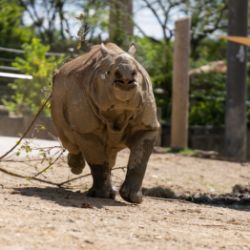
Brian, a six-year-old male Indian rhino, made his public debut in Omaha’s Henry Doorly Zoo and Aquarium’s Asian Highlands exhibit Sunday, October 15. His arrival marks an exciting step forward in Indian rhino conservation.
Brian arrived from Ohio’s Columbus Zoo and Aquarium on Tuesday, September 26. His move to Omaha was recommended per the Association of Zoos and Aquariums’ (AZA) Indian Rhino Species Survival Plan, a program that works to manage genetically diverse, demographically varied and biologically sound populations of threatened or endangered species.
Once Brian has fully acclimated to his new home, he will be paired with Hellary, the Zoo’s 15-year-old female Indian rhino. Currently, guests can spot him in the yard nearest to the takin habitat.
While in Columbus, Brian was known for his soccer skills with various enrichment items, such as his boomer balls, “crashing” mud wallows in the summertime and his eagerness to train with his keepers.
“Brian was eating vegetables and browse within a few minutes of arrival in Omaha, and then began vocalizing back and forth with our female, Hellary,” said Ryan Sears, curator of large mammals at Omaha’s Henry Doorly Zoo and Aquarium. “He also voluntarily participated in a training session the following day and allowed for several diagnostic tests to be performed as part of his quarantine period.”
In accommodating Brian’s arrival, Marshall, the Zoo’s four-year-old Indian rhino and the first-ever Indian rhino calf born in Omaha, moved to the Los Angeles Zoo. There, Marshall will serve as an ambassador for his species and play a vital role in furthering rhino conservation efforts.
Indian rhinos, also known as greater one-horned rhinos, are listed as vulnerable by the International Union for Conservation of Nature’s Red List of Threatened Species. There are about 4,000 Indian rhinos remaining in their native ranges of India and Nepal.
“Human population growth within the Indian rhino’s home range has led to a decrease in habitat and increase in human-animal conflict. Despite these challenges, the recovery of the population for this species has been a conservation success in recent years, due to the changes made in management practices and protective measures,” Sears said. “We are excited to continue to tell this conservation story with Brian.”
Image courtesy: Amanda Carberry, Columbus Zoo and Aquarium




Leave feedback about this