
Nathan Johnson composed the score for Rian Johnson’s three “Knives Out” mysteries, but with each one, they start from scratch. While the character of master detective Benoit Blanc, played by Daniel Craig, has to solve a murder mystery with a colorful range of interconnected suspects in all three movies, each is a distinct genre, and the music plays a big role in communicating the tone to the audience.
In an interview with RogerEbert.com, Johnson talked about setting a gothic tone in the latest, “Wake Up Dead Man: A Knives Out Mystery,” about feeling like Christmas morning when he gets Rian Johnson’s latest script, and about the literal lifelong connection that led to his recording the score for Rian Johnson’s first film, “Brick,” in his tiny apartment.
At the Middleburg Film Festival, you said that the score for this film had to match “Wake Up Dead Man’s” gothic look and tone.
The thing that I love about these is that Rian has no interest in remaking the same movie. They’re technically sequels, but we think of each one really as its own standalone thing. And that applies to everything from the production design to the movie’s structure to the writing to the characters to the music. For the first “Knives Out,” it was this sharp, angular quartet in a claustrophobic New England mansion. For “Glass Onion,” in the Greek Isles, we went big and broad, a lush, romantic orchestra.
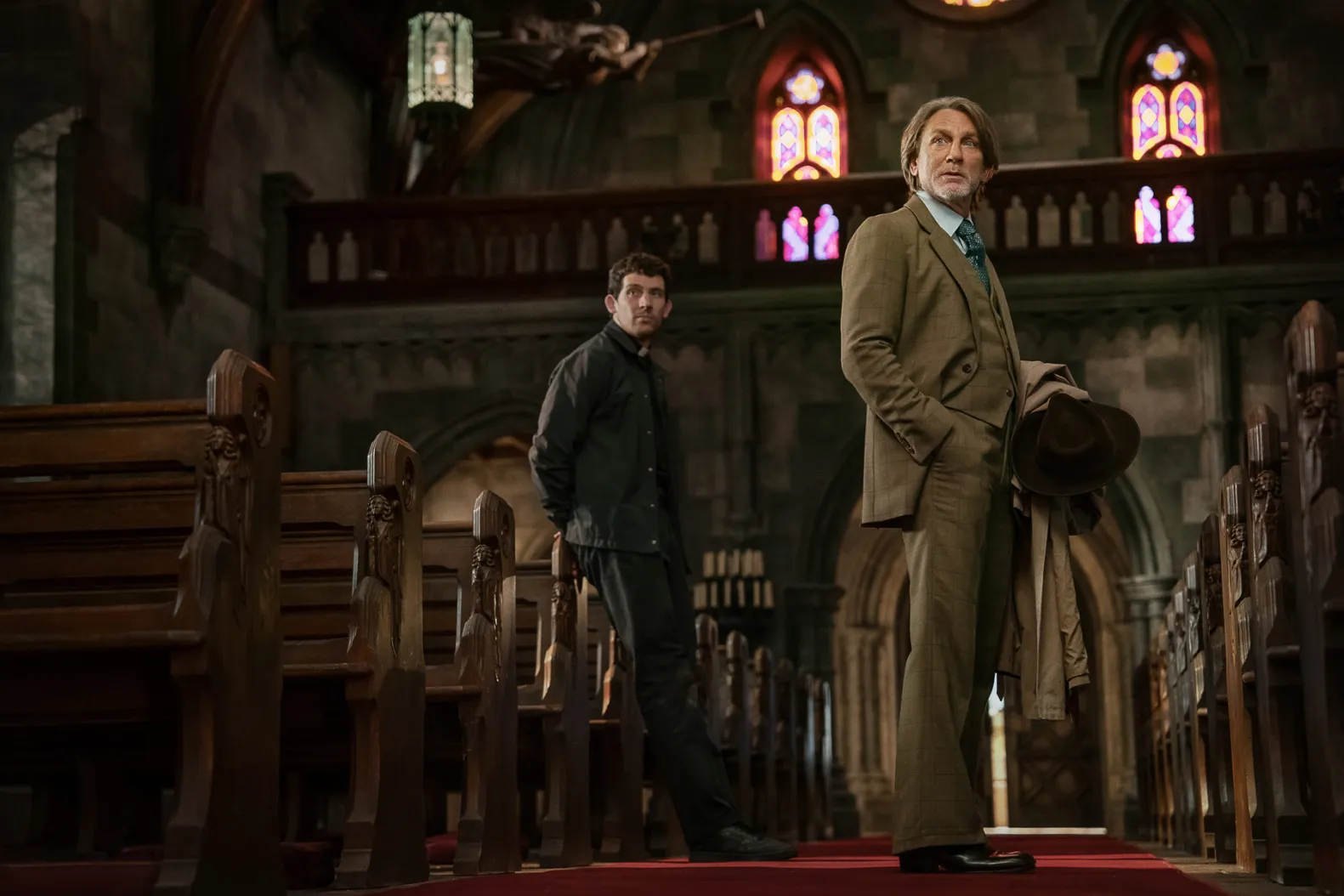
For “Wake Up Dead Man,” it’s darker. It’s gothic. It’s Edgar Allan Poe. The first thing you hear in this score is the sound of the entire string section scraping their bows against the strings, almost like nails on a chalkboard. And then this cacophony resolves into a single pure tone. It’s almost like a tug of war between ugliness and beauty, or between light and dark. In my mind, that’s what this movie is. It’s a tug of war between different people pulling on elements of faith and power, twisting them into dark things or shaping them into generous, beautiful things.
So, that musical theme becomes a conceptual theme throughout the movie: the sound of the strings, like scratching, resolving into a pure tone. And it represents the jewel the film’s characters are hunting for.
I think in our world today, things like money or power or a jewel, depending on who controls them, can tip into light or darkness. That just felt like a real resonant idea to explore. This thing that everybody wants, that everybody is after, can be used for good or evil.
At what stage do you come into it?
Very early. Even before the script is done, Rian pitches the idea to me. And then when he sends over the script, it’s kind of like Christmas morning. It’s my favorite time, getting a new Rian script in my inbox. But I also get to be on set for quite a lot of the filming. I have a mobile rig so that I can write anywhere.
At that point in the production process, music is the last thing on anybody else’s mind. So it allows me to show up on set, be a fly on the wall, and get the vibe of what’s going on, see how the actors are developing what was on the page. Then I’ll go away for a few days and just go exploring. I liken it to being in a dark room, blindly searching until I find what feels like a thread, then following it to see where it goes.
Unlike the first two in the series, this one takes place in an environment that is very closely associated with music, a church. Did that influence your ideas about the score?
It’s something we talked about early on, and we specifically decided not to lean into what would traditionally be considered churchy music. But we’re using elements. There’s a ton of harp in this movie, but we’re using it in quite an odd way, mostly in a rhythmic way. And in one of the key scenes, the harp anchors with just the lowest string being plucked, and an instrument that usually feels so beautiful and heavenly feels like the dread of hell bubbling up from under the surface.
Tell me where you grew up and how you were first involved with music.
I grew up at the base of the Rocky Mountains in Colorado. And I was in garage bands. For a while, I was living in England, playing music there. And that’s where I scored my first movie, which was also Rian’s first movie, “Brick.”
I recorded the whole score in my apartment there with a laptop and one microphone. We had no budget. So instead of a string section, it was tuned wine glasses. And the percussion was like mallets on the filing cabinet in my hallway. It was one of those examples of restriction being the mother of invention.
It’s a pretty weird movie set in a high school. And I think I think in Rian’s ideal high school, everyone listened to Tom Waits, so that inspired that broken-down, slightly out-of-tune, rusty feel.

So, you met Rian when you were performing in Europe?
Rian and I are cousins, actually. He’s the oldest of 25 cousins, and I’m next in line. He’s three years older than me. So we’ve actually been doing plays and making music and making movies since we were pretty young kids together.
You composed the score for “Poker Face,” too. Are you developing a specialty in quirky, star-packed mysteries?
I guess I’ve done a number of them now. Rian has talked about this; the mystery is an element of it, but clue-gathering will never sustain an audience through a movie. What really has to be there is the heart and the emotional stakes for the characters. That’s usually my first point of entry to these movies. I appreciate the puzzle-box nature of it, but as a composer, what I’m really tuning into is character motivation and the emotional tension moving through the movie.
I try as much as possible to come to it with a clean slate and let the characters begin to inform me. I’m not the kind of composer who thinks, “I want to do this type of movie because I want to do this type of music.” It really is just about showing up and letting the characters start speaking to me.
For example, this movie, when I watched the first edit of it, was the first movie of Rian’s that made me cry. And I knew immediately I wanted to protect that. There’s a moment at the very end of it where there is this generosity and connection, and it snuck up on me. We’re watching a murder mystery, but it has this really generous, I think, anchor. And so I went home, and that was the first thing I started working on. If that moment doesn’t work, the whole movie doesn’t work. And then it becomes a fun puzzle-solving exercise. This feels like I’m trying to talk about an ethereal, smoke-filled thing, but I guess in a way that is what it feels like.
The specific challenge, especially with these movies, is that they’re very dense. So, in a “Knives Out” movie, you’re never going to have a five-minute scene where the music takes over and you get moody shots of somebody thinking. Because of the way they’re constructed, they’re moving at quite a clip, and there’s a lot of dialogue going on. The challenge is how to assist the emotion and the engine. It becomes a really interesting needle to thread. In these, more than most movies, my job is to disappear and be felt more than heard.
Leave feedback about this